


A Basic Misunderstanding of “Basal”: Tree-thinking Revisited
Adapted into English by Jing-Xuan Chen, 10 October 2026, Hangzhou
This is an English adaptation of a science communication blog that I originally wrote in Chinese with my PI, Xing-Xing Shen, at the invitation of our research center. The original Chinese article is available here.
Overview
Why do we call some living organisms “basal,” as though they stood closer to the beginning of evolution than others? Starting with this familiar but misleading label, we explore what it means to practice tree-thinking. Reading a phylogeny correctly is only part of the task. We must also distinguish what we can observe, what we infer about the past, and what remains uncertain. Why do branching trees so easily become ladders of progress in our minds? Why is no living lineage a stand-in for an ancestor? What gets lost when conflicting signals are compressed into a single tree? And how can we reconstruct ancestral traits without simply projecting living organisms into the past? These questions are connected by a common way of thinking about evolutionary history.
The language scientists use does not always reflect the science as clearly as we might hope. Sometimes a familiar term reveals more about how we habitually picture a problem than about the problem itself. In evolutionary biology, “basal lineage” is one such term.
In conversation, calling a group “basal” can be a handy shortcut. Say that monotremes—the platypus and echidnas—occupy the base of the mammal tree, and most biologists will know what you mean (Fig. 1).
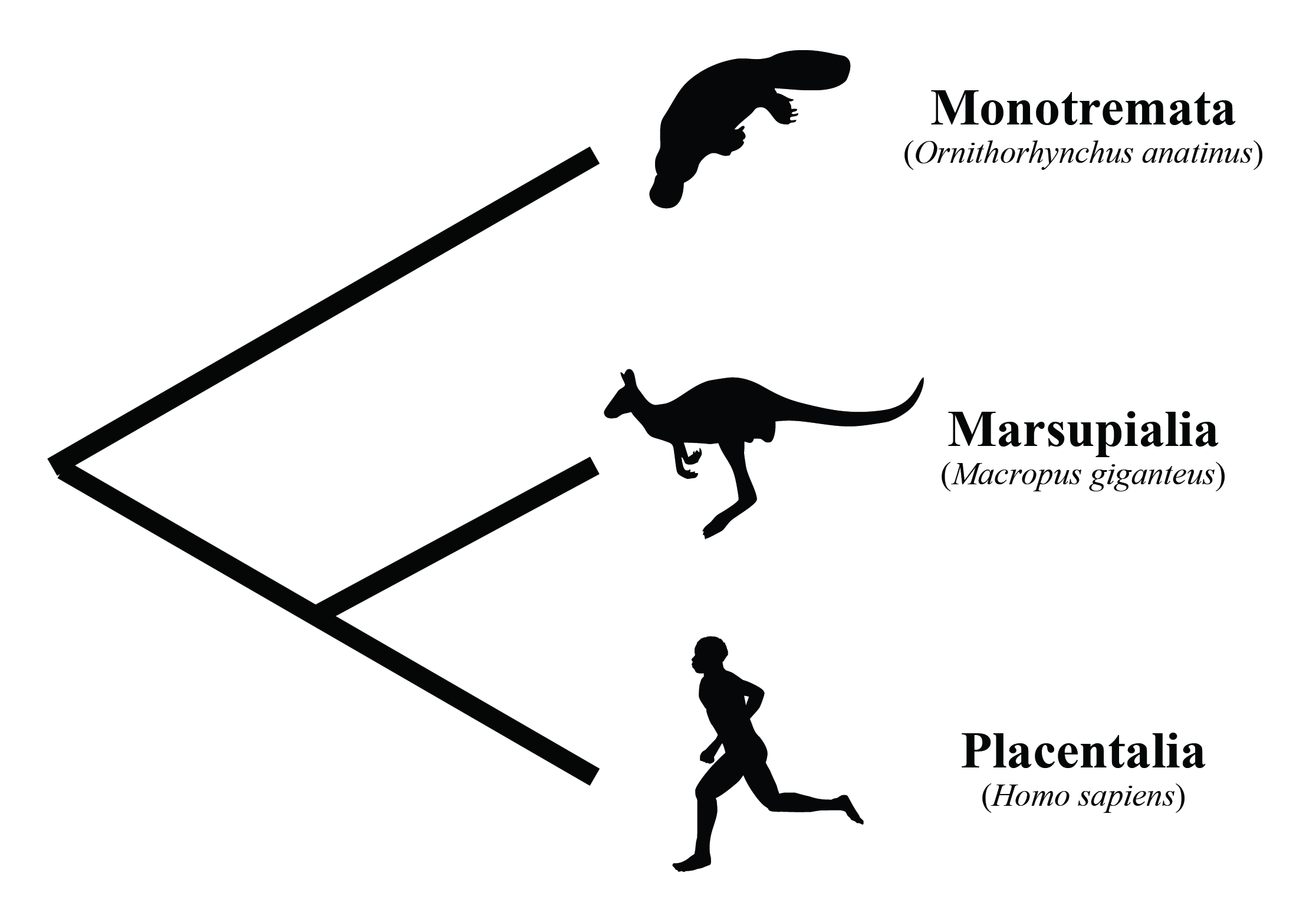
Fig. 1. Simplified relationships among living mammals. Monotremata is sister to Marsupialia + Placentalia. Silhouettes from PhyloPic: Ornithorhynchus anatinus by Sarah Werning (CC BY 3.0); Macropus by Jiekun He (CC0 1.0); Homo sapiens by T. Michael Keesey (CC0 1.0).
But consider what the tree actually shows. Every split in a rooted, bifurcating tree produces two sister lineages. If both have living descendants, neither side is more basal than the other with respect to that split. Some nodes lie nearer the root than others, of course. That does not make one of the two living sister lineages uniquely “basal” (1–3).
The word also invites a second mistake. Applied to a living group, “basal” can quietly slip into meaning “more ancestral,” “older,” or “more primitive” (3, 4). Before long, a position on a tree has become a claim about what an organism is like.
This is hardly a relic of older biological writing. We searched PubMed titles and abstracts for expressions including basal lineage, basal taxon, and basal clade, then removed records where the terms referred to something else. We still found 1,652 records that clearly used “basal” for an extant taxon: 1,065 involving animals, 297 plants, and 110 fungi, with the rest spread across other eukaryotes, bacteria, archaea, and viruses (Fig. 2A).
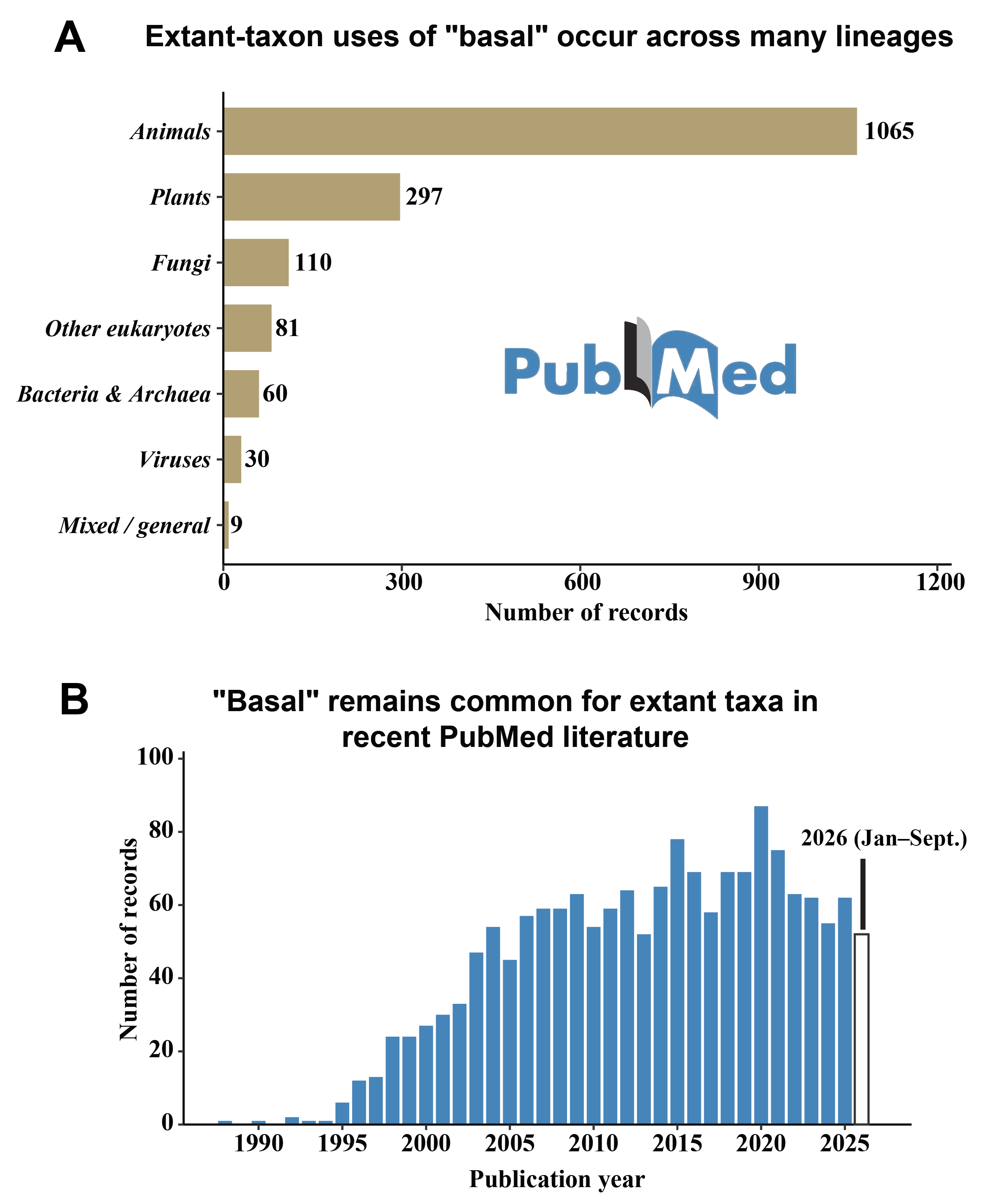
Fig. 2. Distribution of PubMed records in which “basal” is used to describe extant taxa. We searched titles and abstracts for expressions including basal lineage, basal taxon, and basal clade, and excluded non-phylogenetic uses, fossil taxa, and other irrelevant records according to context. A total of 1,652 records clearly used basal to describe an extant taxon. A. Distribution of these records among major organismal groups. B. Distribution of these records by publication year. Data are current through 27 September 2026. Panel A shows raw record counts to illustrate the taxonomic breadth of this usage and is not standardized by the total publication output of each group; panel B likewise shows raw annual counts and should not be used to compare usage proportions among years.
And the usage is not fading away. Our search found 342 such records published from 2020 through 2024, another 62 in 2025, and already 52 in the first nine months of 2026 (Fig. 2B).
Why does it feel so natural to call a living lineage “basal” simply because it is sister to the rest of a group?
When Trees Look Like Ladders
Part of the answer lies in how we draw them. Phylogenetic trees are often ladderized: species-poor lineages peel off in sequence along one side, while a species-rich group fills the other. On the page, those side branches can look like departures from a main path, one that leads onward toward the group at the far end. Yet we can rotate branches around their nodes without changing a single evolutionary relationship. Redraw the same tree, and much of the sense of progress disappears (Fig. 3).
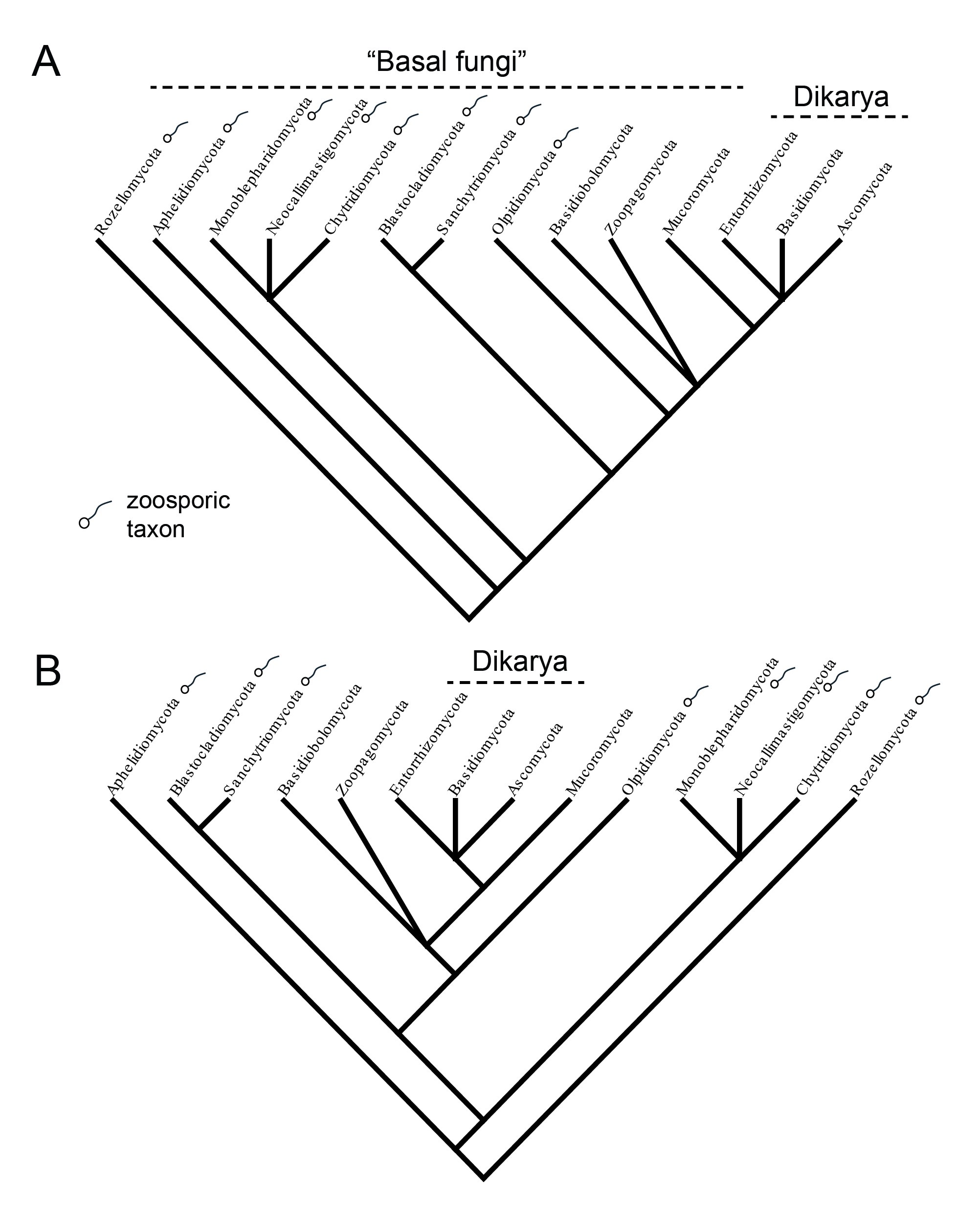
Fig. 3. The same relationships can look very different depending on how a tree is drawn. James and Rokas (2025) noted that fungal phylogenies are often ladderized, with species-poor lineages arranged along one side and Dikarya appearing to occupy the evolutionary endpoint. A. A typical ladderized tree. B. The branches have been rearranged without changing the topology, weakening the misleading impression of a progression from “lower” to “higher.” Redrawn from James & Rokas (2025).
The layout, however, is only part of the story. The harder habit to shake is our tendency to see a branching history as a ladder of evolution.
Think of the platypus. Or of Polypterus, the African bichir.
A platypus hunting in the murky rivers of Australia closes its ear openings and nostrils and searches for prey using electroreceptors in its bill. Males also carry a venom-delivering spur on the hind legs (5). In African tropical wetlands, Polypterus periodically surfaces to draw air through its spiracles. Its muscular body and well-developed pectoral fins help it move in shallow water and, under some conditions, out of it; its larvae bear prominent external gills (6, 7). These are remarkable ways of living, shaped by evolutionary histories of their own. Seen on their own terms, neither animal readily suggests the word “primitive” (Fig. 4).
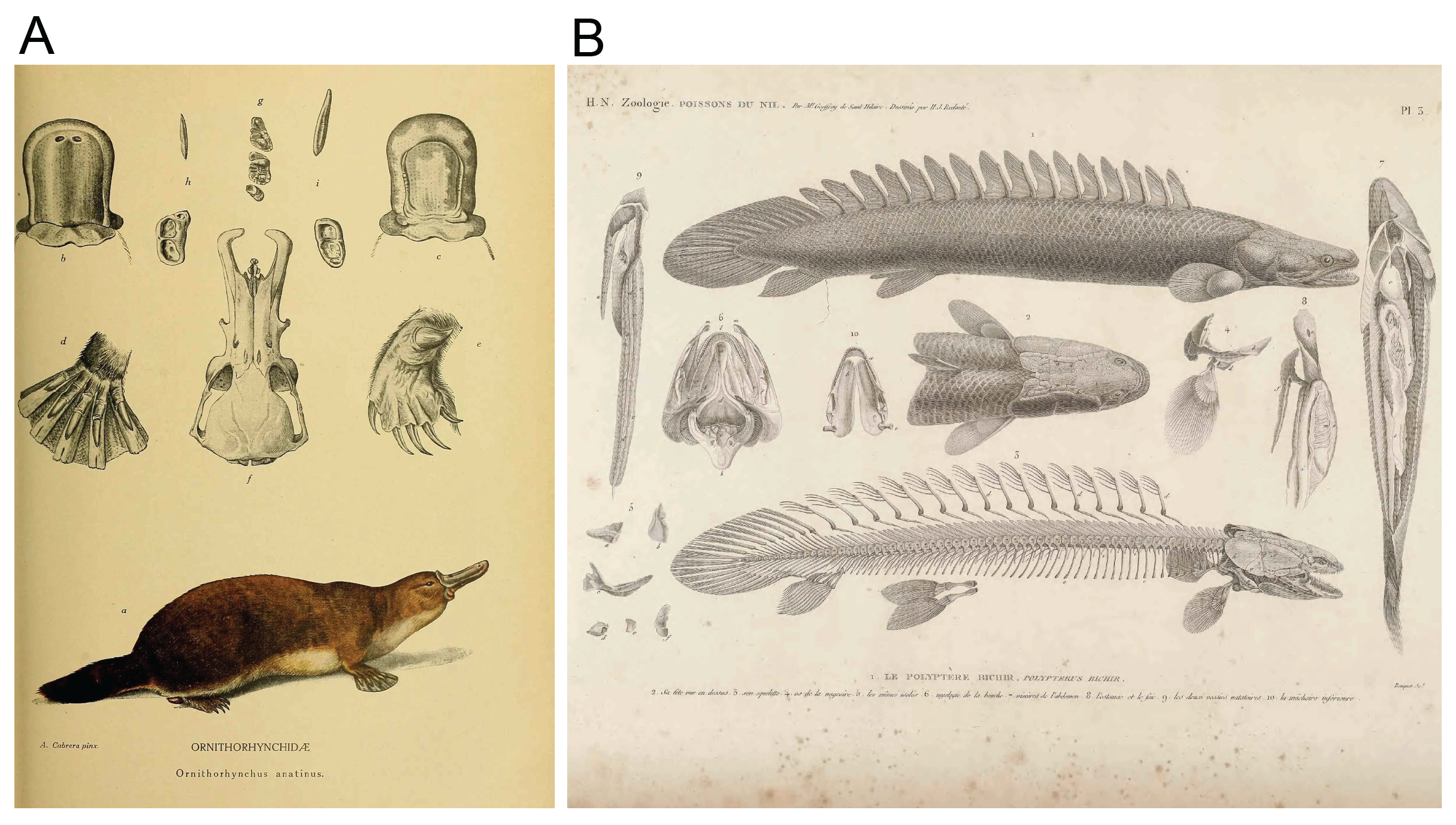
Fig. 4. Platypus and Polypterus. A. Platypus (Ornithorhynchus anatinus), from Genera mammalium (Madrid, 1919), Monotremata, Lam. II, illustrated by A. Cabrera. B. Polypterus bichir, from Description de l’Égypte, Histoire naturelle, atlas t. 1 (1809), Poissons du Nil, Pl. 3. Both images were accessed through the Biodiversity Heritage Library; collection: Smithsonian Libraries and Archives.
Most people who know even a little evolutionary biology would not say that monkeys living today are our ancestors. Change the question slightly, though, and the answer becomes less obvious. Was the ancestor of mammals rather like a platypus? Does Polypterus preserve the ancestral condition of ray-finned fishes?
Here is where the trouble begins: we turn a lineage’s position on a diagram into a judgment about the whole organism. That takes us beyond a dispute over terminology and into the larger challenge of tree-thinking. Tree-thinking means more than spotting sister groups. It means using common ancestry and branching history to frame questions about evolution—and resisting the urge to read into a tree things it cannot tell us (8).
One Species, Many Evolutionary Histories
Calling a living lineage “basal” often encourages us to treat it as a closer approximation of an ancestor. But that assumes something we should question at the outset: that a species can be described by a single evolutionary state.
In phylogenetics, plesiomorphic and apomorphic describe character states: whether a particular feature retains an ancestral condition or represents a derived one. An ancestral state is not inferior, and a derived state is not necessarily an improvement. Every living species carries a mosaic of traits with different histories. The same organism can be plesiomorphic for one character and apomorphic for another.
Even this distinction took time to emerge. In 1949, Willi Hennig was already using plesiomorphic and apomorphic, but he initially applied them to taxa rather than to characters. After a split, a lineage that seemed to have changed relatively little could be called a plesiomorphic taxon; its more altered sister, an apomorphic taxon.
Then came a complication (Fig. 5).
A group could retain an ancestral state for one character while showing a derived state for another (9). Hennig and his contemporaries discussed such patterns as “specialization crossings.” They helped prompt a crucial change in his thinking: plesiomorphic and apomorphic should describe particular character states, not entire taxa. The question was no longer whether a whole group was primitive, but how different features had evolved.
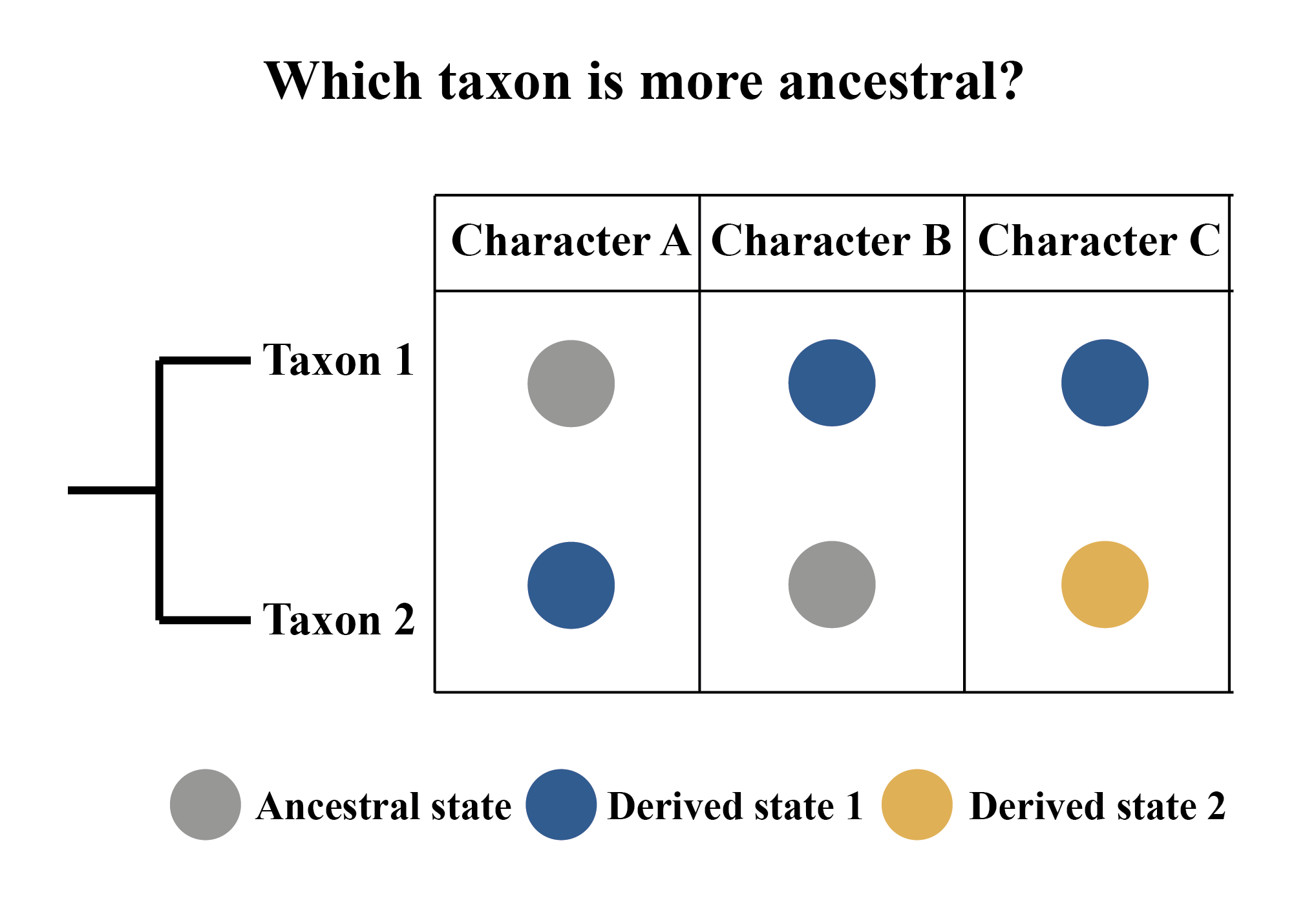
Fig. 5. For character A, Taxon 1 retains the ancestral state while Taxon 2 has a derived state; for character B, the relationship is reversed; for character C, the two taxa possess different derived states. Plesiomorphic and apomorphic therefore describe particular character states and cannot simply be generalized into properties of whole extant taxa. Schematic based on the concept of specialization crossings discussed by Richter & Meier (1994).
Others were grappling with related questions. Julian Huxley spoke of clades—branches of the evolutionary tree—but also of grades, a concept still suggestive of steps on a ladder (10). Ernst Mayr and George Gaylord Simpson argued that classification ought to capture not only common ancestry, but also the extent of evolutionary change and the adaptive forms that emerged from it (11, 12). These were tree-based views of evolution, yet they still left room for ranking groups by how far they had supposedly evolved.
The shift from grading whole organisms to reconstructing the histories of individual characters was neither immediate nor straightforward. And with the rise of molecular systematics, the same underlying problem took on another form.
From Sequences to Competing Histories
So far we have been asking how to read a tree. But before interpreting it, we need to ask a more basic question: how did we get that tree in the first place?
A phylogenetic tree is a hypothesis about history, inferred from observations using particular methods and models (13, 14). Whether something appears “basal” therefore depends first on the tree under discussion. And that tree depends on the data we have chosen and the relationships those data support (15).
We encountered this problem ourselves in work on the long-running debate over the root of the animal tree.
Put simply, the debate asks which group—sponges or ctenophores—is sister to all other living animals (16, 17). This is a genuine question about the position of the root, and thus about the relationships among major animal lineages. It is not a contest to identify the most “primitive” animal alive.
In examining gene-level scores from a published dataset, we found two opposing signals (Fig. 6). Across the scoring criteria we considered, 174 genes consistently favored sponges as sister to the remaining animals, while 370 favored ctenophores. When all 544 genes were concatenated, the analysis recovered ctenophores as sister to the rest (18).
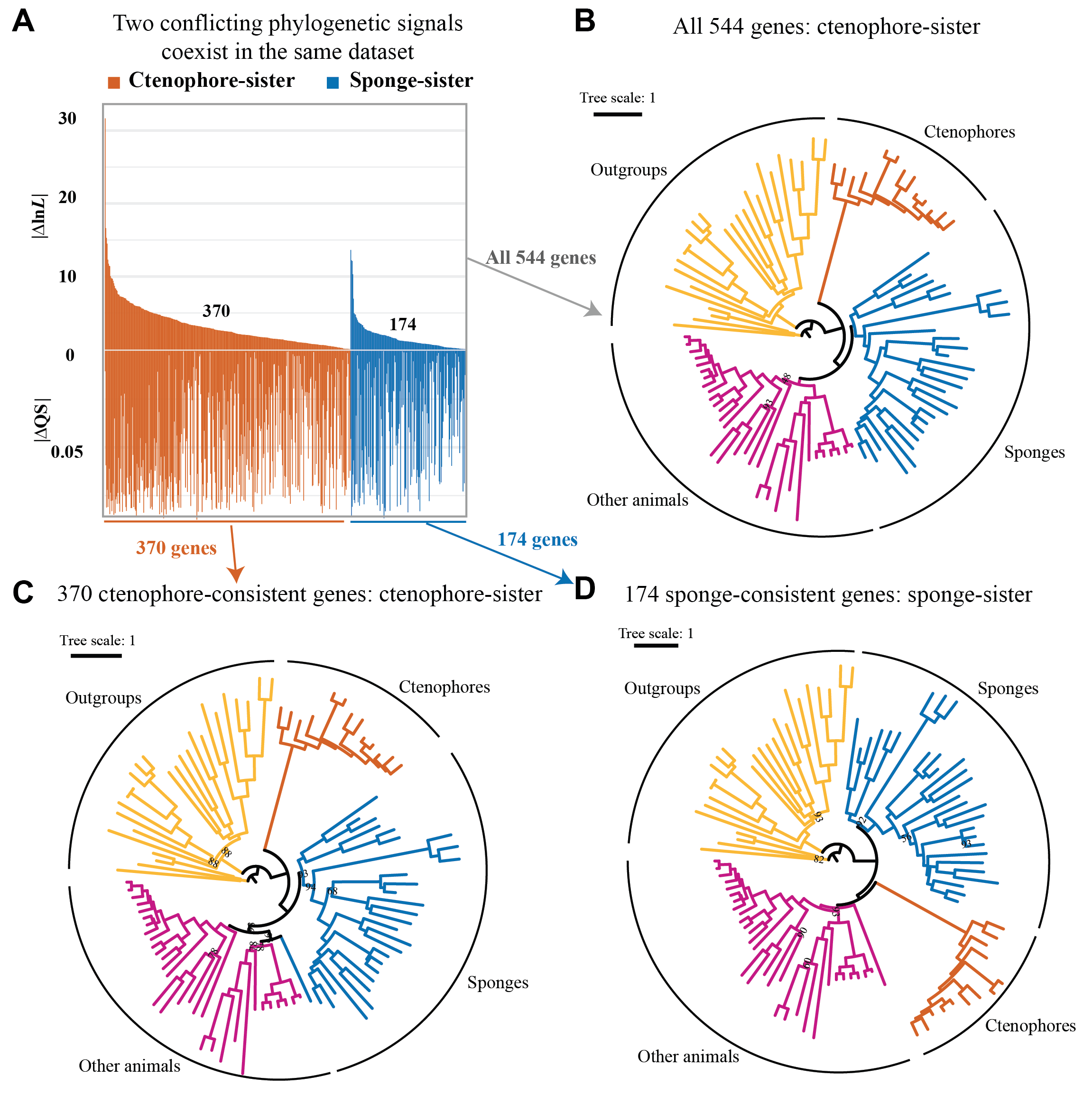
Fig. 6. Gene-level signals supporting sponge-sister and ctenophore-sister relationships in the same phylogenetic dataset, together with concatenation analyses. A. Among 544 genes whose directions were consistent across different gene-level scoring metrics, 370 were consistent with the ctenophore-sister relationship and 174 with the sponge-sister relationship. B. Concatenation of all 544 genes yielded a ctenophore-sister topology. C. Concatenation of the 370 ctenophore-consistent genes yielded a ctenophore-sister topology. D. Concatenation of the 174 sponge-consistent genes yielded a sponge-sister topology. The latter two analyses were used to test whether the two sets of gene-level signals could each reconstruct a topology consistent with their scoring direction. Redrawn from Dunn et al. (2025); gene-scoring metrics, classification criteria, and analysis details are provided in that work and its associated data archive (Zenodo, DOI: 10.5281/zenodo.18022339).
The striking point was not simply which topology the combined analysis produced. It was that the same dataset contained substantial signals for both alternatives. We also concatenated the two sets separately to check whether each could recover a topology consistent with its gene-level scores. This was a control, not an attempt to prove two incompatible hypotheses by selectively assembling data. Equally, a combined analysis favoring one hypothesis does not erase the conflicting signal in the underlying genes.
Which tree, then, is right?
We hope that this long debate will eventually lead us closer to what happened. For now, the scientific task is to weigh the evidence for each hypothesis and investigate why the signals disagree. Different genes can favor different histories. The disagreement may reflect real differences among gene histories, limited information, inadequate models, or errors of inference (19, 20). Before we can judge among these possibilities, we must first acknowledge the disagreement itself. We should not begin by treating one tree as the truth and everything that conflicts with it as noise.
There is an echo here of the “specialization crossings” that troubled Hennig. Different characters in one organism can follow different evolutionary paths; likewise, genes in the same genome need not share a single history merely because they occur together (21).
Molecular data have not made tree-thinking easier. They have made its demands more apparent. Whether our evidence comes from anatomy or DNA, reducing many histories to one tidy picture can hide the very differences we need to explain. That brings us back to “basal.” If even the question of which animal lineage is sister to all the others can receive conflicting support from different genes, how much further are we straying when we take one position on one tree and declare an entire living lineage closer to the ancestor?
“The Ancestors Are Not Among Us”
Recognizing competing phylogenetic hypotheses is only the beginning. Sponges lack a nervous system in the conventional sense, whereas ctenophores have neurons and muscles. That contrast gives the two possible roots very different implications for how we understand animal evolution.
Suppose sponges are sister to all other living animals. If we take living sponges as a direct picture of the ancestor, the story almost writes itself: the first animals were simple, without nervous systems or true muscles, and complex structures appeared later. Now suppose ctenophores occupy that position instead. The simple story falls apart. Did nervous systems evolve more than once? Did sponges lose complex structures? How many times did particular traits arise?
Casey Dunn, Sally Leys, and Steve Haddock raised a related concern in their discussion of the “hidden biology” of sponges and ctenophores (Fig. 7). When we study animals distant from familiar model organisms, we are often quicker to notice what they lack than to appreciate the biological complexity they possess (22).
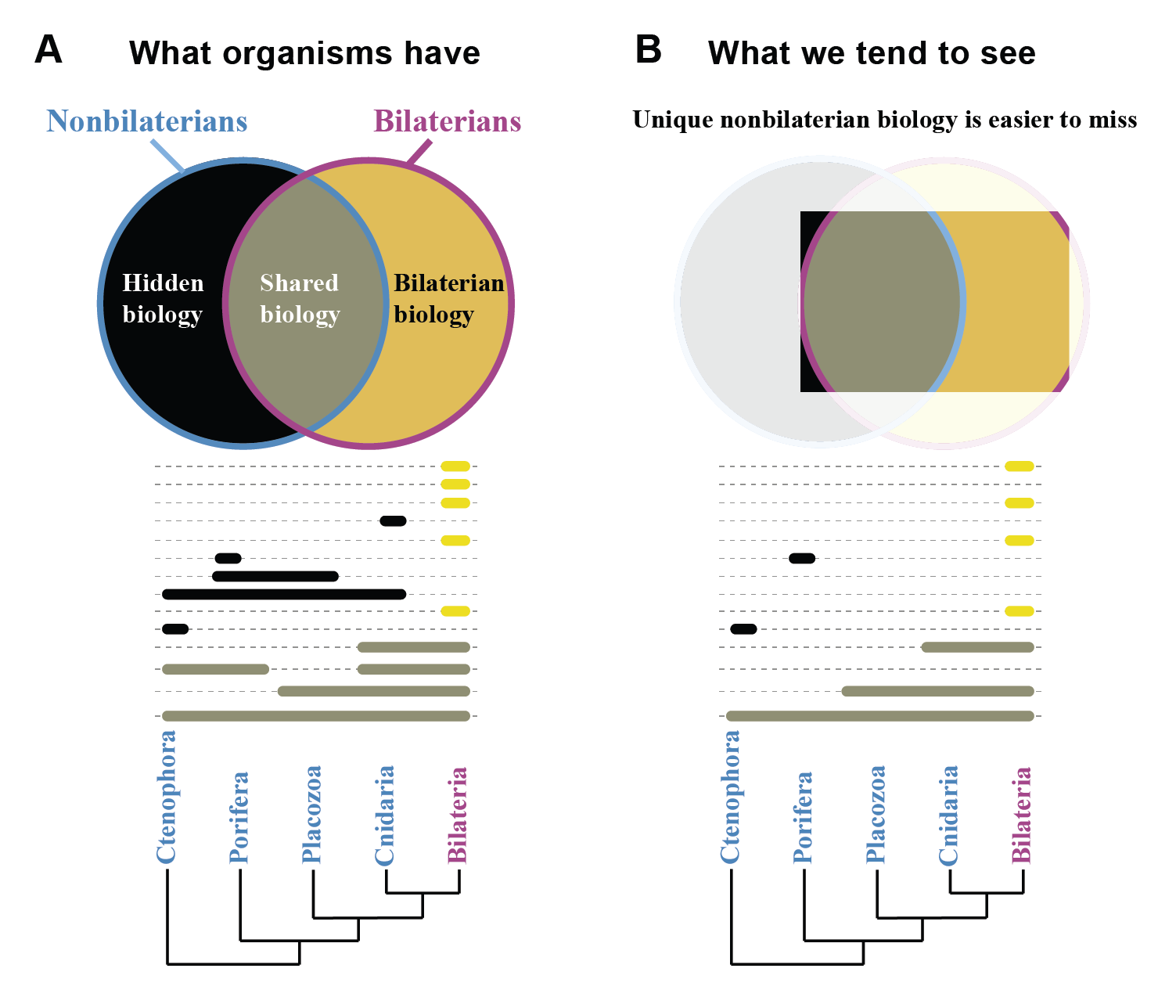
Fig. 7. Zoological research has long focused heavily on bilaterians. As a result, when researchers study non-bilaterian animals such as sponges and ctenophores, traits shared with bilaterians are often easier to notice than structures and functions unique to those non-bilaterian lineages. This observational bias can make these groups look like simplified versions of bilaterians and, in turn, influence our understanding of the animal common ancestor and the evolution of complex traits. A. Different animal groups contain traits shared with other groups as well as lineage-specific structures and functions. B. We are more likely to recognize features that other animals share with bilaterians than the unique biology of those lineages. Image adapted from Dunn, Leys & Haddock (2015).
This is not an argument that sponges must harbor some undiscovered complexity before we can stop calling them “lower.” Nor should the nervous system of a ctenophore make it “higher.” Having or lacking neurons is a difference to investigate, not a place on a scale of evolutionary worth.
This is what tree-thinking makes possible: it replaces broad impressions with questions we can test. The ancestors are not among us. We must reconstruct their traits one at a time, using different kinds of evidence. Even where no single explanation has yet prevailed, we can still be clear about what the evidence supports and what rests on assumptions still to be tested (23).
Return for a moment to the platypus and bichir. The platypus has no reason to care where we place it on a mammal tree. Its extraordinary body helps it find food and survive. Monotremes split from the lineage leading to other living mammals long ago, but their evolution did not stop at that split. Similarly, seeing a living bichir breathe air through its spiracles helps us develop hypotheses about extinct fishes with comparable skull structures (6). It offers a living example of how such a structure can function—not a snapshot of an extinct ancestor delivered by a conveniently placed branch (Fig. 8).
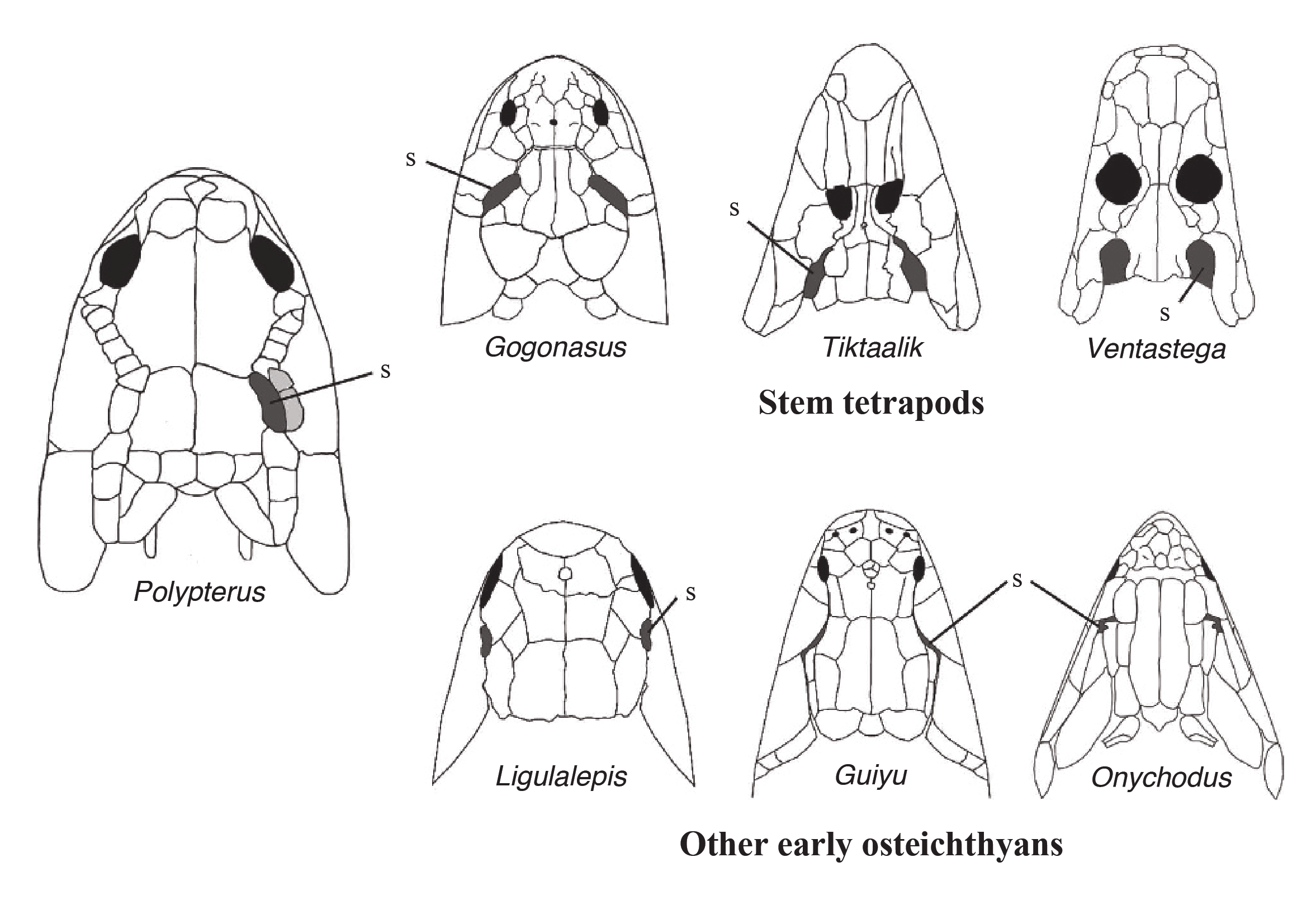
Fig. 8. Living Polypterus provides a comparative structural and functional mechanism, not a direct reconstruction of extinct lineages. In living Polypterus (left), the spiracle (s) can participate in air breathing. Graham et al. (2014) compared this condition with corresponding cranial structures in several stem tetrapods (upper right) and other early osteichthyans (lower right), and used the comparison to discuss the possible role of spiracular air breathing in the fish-to-tetrapod transition. Image from Graham et al. (2014).
Observing living organisms, testing how they work, proposing hypotheses, and placing those findings in a phylogenetic context are not separate endeavors. Together, they allow us to ask which evolutionary explanations fit the evidence and where more work is needed. A tree cannot tell the whole story of a lineage. But it connects centuries of observations and, in doing so, opens up new questions (24).
What, then, should we do with “basal”? The word can still be useful for describing nodes or branching events nearer the root. The mistake is to make “basal” an identity assigned to a living lineage. Switching labels does not necessarily solve it. “Early-diverging lineage” may sound less like a rank on a ladder, but if it singles out just one of two living sister lineages, it still transfers the age of a branching event onto one of its descendants (25).
Perhaps the most useful habit in tree-thinking is not learning a better label for every branch. It is learning to ask what a tree shows—and what it leaves unresolved. Between a common ancestor and the organisms alive today lies a history of change on every surviving branch. We can follow our own lineage back into that history. We need not imagine that every other lineage was headed in our direction (26).
References
1. F.-T. Krell, P. S. Cranston, Which side of the tree is more basal? Syst. Entomol. 29, 279–281 (2004).
2. M. D. Crisp, L. G. Cook, Do early branching lineages signify ancestral traits? Trends Ecol. Evol. 20, 122–128 (2005).
3. T. Y. James, A. Rokas, Use their names: there are no basal, lower, or early diverging fungi. Mycologia 117, 246–254 (2025).
4. K. E. Omland, L. G. Cook, M. D. Crisp, Tree thinking for all biology: the problem with reading phylogenies as ladders of progress. Bioessays 30, 854–867 (2008).
5. W. C. Warren, L. W. Hillier, J. A. Marshall Graves, E. Birney, C. P. Ponting, F. Grützner, K. Belov, W. Miller, L. Clarke, A. T. Chinwalla, S.-P. Yang, A. Heger, D. P. Locke, P. Miethke, P. D. Waters, F. Veyrunes, L. Fulton, B. Fulton, T. Graves, J. Wallis, X. S. Puente, C. López-Otín, G. R. Ordóñez, E. E. Eichler, L. Chen, Z. Cheng, J. E. Deakin, A. Alsop, K. Thompson, P. Kirby, A. T. Papenfuss, M. J. Wakefield, T. Olender, D. Lancet, G. A. Huttley, A. F. A. Smit, A. Pask, P. Temple-Smith, M. A. Batzer, J. A. Walker, M. K. Konkel, R. S. Harris, C. M. Whittington, E. S. W. Wong, N. J. Gemmell, E. Buschiazzo, I. M. Vargas Jentzsch, A. Merkel, J. Schmitz, A. Zemann, G. Churakov, J. Ole Kriegs, J. Brosius, E. P. Murchison, R. Sachidanandam, C. Smith, G. J. Hannon, E. Tsend-Ayush, D. McMillan, R. Attenborough, W. Rens, M. Ferguson-Smith, C. M. Lefèvre, J. A. Sharp, K. R. Nicholas, D. A. Ray, M. Kube, R. Reinhardt, T. H. Pringle, J. Taylor, R. C. Jones, B. Nixon, J.-L. Dacheux, H. Niwa, Y. Sekita, X. Huang, A. Stark, P. Kheradpour, M. Kellis, P. Flicek, Y. Chen, C. Webber, R. Hardison, J. Nelson, K. Hallsworth-Pepin, K. Delehaunty, C. Markovic, P. Minx, Y. Feng, C. Kremitzki, M. Mitreva, J. Glasscock, T. Wylie, P. Wohldmann, P. Thiru, M. N. Nhan, C. S. Pohl, S. M. Smith, S. Hou, M. B. Renfree, E. R. Mardis, R. K. Wilson, Genome analysis of the platypus reveals unique signatures of evolution. Nature 453, 175–183 (2008).
6. J. B. Graham, N. C. Wegner, L. A. Miller, C. J. Jew, N. C. Lai, R. M. Berquist, L. R. Frank, J. A. Long, Spiracular air breathing in polypterid fishes and its implications for aerial respiration in stem tetrapods. Nat. Commun. 5, 3022 (2014).
7. E. M. Standen, T. Y. Du, H. C. E. Larsson, Developmental plasticity and the origin of tetrapods. Nature 513, 54–58 (2014).
8. R. J. O’Hara, Population thinking and tree thinking in systematics. Zool. Scr. 26, 323–329 (1997).
9. S. Richter, R. Meier, The development of phylogenetic concepts in Hennig’s early theoretical publications (1947–1966). Syst. Biol. 43, 212–221 (1994).
10. J. Huxley, The three types of evolutionary process. Nature 180, 454–455 (1957).
11. G. G. Simpson, Principles of Animal Taxonomy (Columbia University Press, 1961; https://doi.org/10.7312/simp92414).
12. E. Mayr, Cladistic analysis or cladistic classification? J. Zool. Syst. Evol. Res. 12, 94–128 (1974).
13. D. A. Baum, S. D. Smith, S. S. S. Donovan, The tree-thinking challenge. Science 310, 979–980 (2005).
14. D. A. Baum, S. D. Smith, Tree Thinking: An Introduction to Phylogenetic Biology (Roberts and Company Publishers, 2013).
15. X.-X. Shen, C. T. Hittinger, A. Rokas, Contentious relationships in phylogenomic studies can be driven by a handful of genes. Nat. Ecol. Evol. 1, 126 (2017).
16. C. W. Dunn, A. Hejnol, D. Q. Matus, K. Pang, W. E. Browne, S. A. Smith, E. Seaver, G. W. Rouse, M. Obst, G. D. Edgecombe, M. V. Sørensen, S. H. D. Haddock, A. Schmidt-Rhaesa, A. Okusu, R. M. Kristensen, W. C. Wheeler, M. Q. Martindale, G. Giribet, Broad phylogenomic sampling improves resolution of the animal tree of life. Nature 452, 745–749 (2008).
17. C. W. Dunn, G. Giribet, G. D. Edgecombe, A. Hejnol, Animal phylogeny and its evolutionary implications. Annu. Rev. Ecol. Evol. Syst. 45, 371–395 (2014).
18. C. W. Dunn, X. Zhou, J. Chen, J. M. Musser, Y. Li, S. H. D. Haddock, D. S. Rokhsar, X.-X. Shen, Re. Integrative phylogenomics positions sponges at the root of the animal tree, Science eLetters (2025). https://www.science.org/doi/10.1126/science.adw9456#elettersSection.
19. W. P. Maddison, Gene trees in species trees. Syst. Biol. 46, 523–536 (1997).
20. J. L. Steenwyk, Y. Li, X. Zhou, X.-X. Shen, A. Rokas, Incongruence in the phylogenomics era. Nat. Rev. Genet. 24, 834–850 (2023).
21. S. V. Edwards, Is a new and general theory of molecular systematics emerging? Evolution 63, 1–19 (2009).
22. C. W. Dunn, S. P. Leys, S. H. D. Haddock, The hidden biology of sponges and ctenophores. Trends Ecol. Evol. 30, 282–291 (2015).
23. C. W. Cunningham, K. E. Omland, T. H. Oakley, Reconstructing ancestral character states: a critical reappraisal. Trends Ecol. Evol. 13, 361–366 (1998).
24. J. C. Uyeda, R. Zenil-Ferguson, M. W. Pennell, Rethinking phylogenetic comparative methods. Syst. Biol. 67, 1091–1109 (2018).
25. J. M. Beaulieu, A. J. Alverson, B. C. O’Meara, Early-diverging lineages provide little information about ancestors. Syst. Biol., syag074 (2026).
26. M. J. Landis, M. J. Donoghue, Seventy-five years of systematic biology: looking back, moving forward. Syst. Biol. 75, 3–13 (2026).
Further Reading
Baum, D. A. 2008. Trait Evolution on a Phylogenetic Tree: Relatedness, Similarity, and the Myth of Evolutionary Advancement. Nature Education 1(1):191. https://www.nature.com/scitable/topicpage/trait-evolution-on-a-phylogenetic-tree-relatedness-41936/
Morrison, D. A. 2015. “Basal” and “crown” are dirty words in phylogenetics. The Genealogical World of Phylogenetic Networks. 3 June 2015. https://phylonetworks.blogspot.com/2015/06/basal-and-crown-are-dirty-words-in.html
Smith, S. D. 2016. The ancestors are not among us. For the Love of Trees. 19 September 2016. https://for-the-love-of-trees.blogspot.com/2016/09/the-ancestors-are-not-among-us.html